Ask about freeze-thaw damage in a place famous for mild winters and you are really asking about water. A South Seattle chimney spends the better part of each year damp, and on the clear, still nights when the temperature dips to freezing, the water already sitting in the brick and mortar expands. That combination, more than any hard winter, is what slowly opens joints, cracks crowns and pops the faces off bricks. This guide explains the mechanism, the signs, and how repairs are handled under Seattle's chimney rules.
Mild on paper, wet in practice
By the numbers, a South Seattle winter is gentle. WeatherSpark dates Seattle's cool season November 12 through March 1; its coldest month, December, swings between an average 38 at night and 47 by day, and readings under 28 are rare. Its model of the Boeing Field station, the station beside Georgetown at the foot of Beacon Hill, is a degree colder at night. Snow in the lowlands, typically 10 to 20 inches over a season, generally melts within days, says the Western Regional Climate Center.
What the averages hide is the moisture. That climate center finds that a lowland winter month offers between four and eight days without solid cloud, and WeatherSpark puts November rainfall near seven and a half inches. Brick that is rained on every few days and rarely sees sun never dries out between storms. Then a clear night comes along. The climate center's January lows of 28 to 32 degrees mean the masonry sits right at the freezing line on those nights, and by its reckoning, only the months from late April to mid-October are reliably clear of frost.
How water and frost take a chimney apart
Ice takes up more room than the water it came from. In a dry brick that does nothing; in a saturated one, the ice has nowhere to go and pushes on the pores and the hairline cracks around it. One night of that is harmless. Years of it, on a chimney that stays wet from October to April, widen the cracks a little each time, and the next rain fills a slightly larger gap.
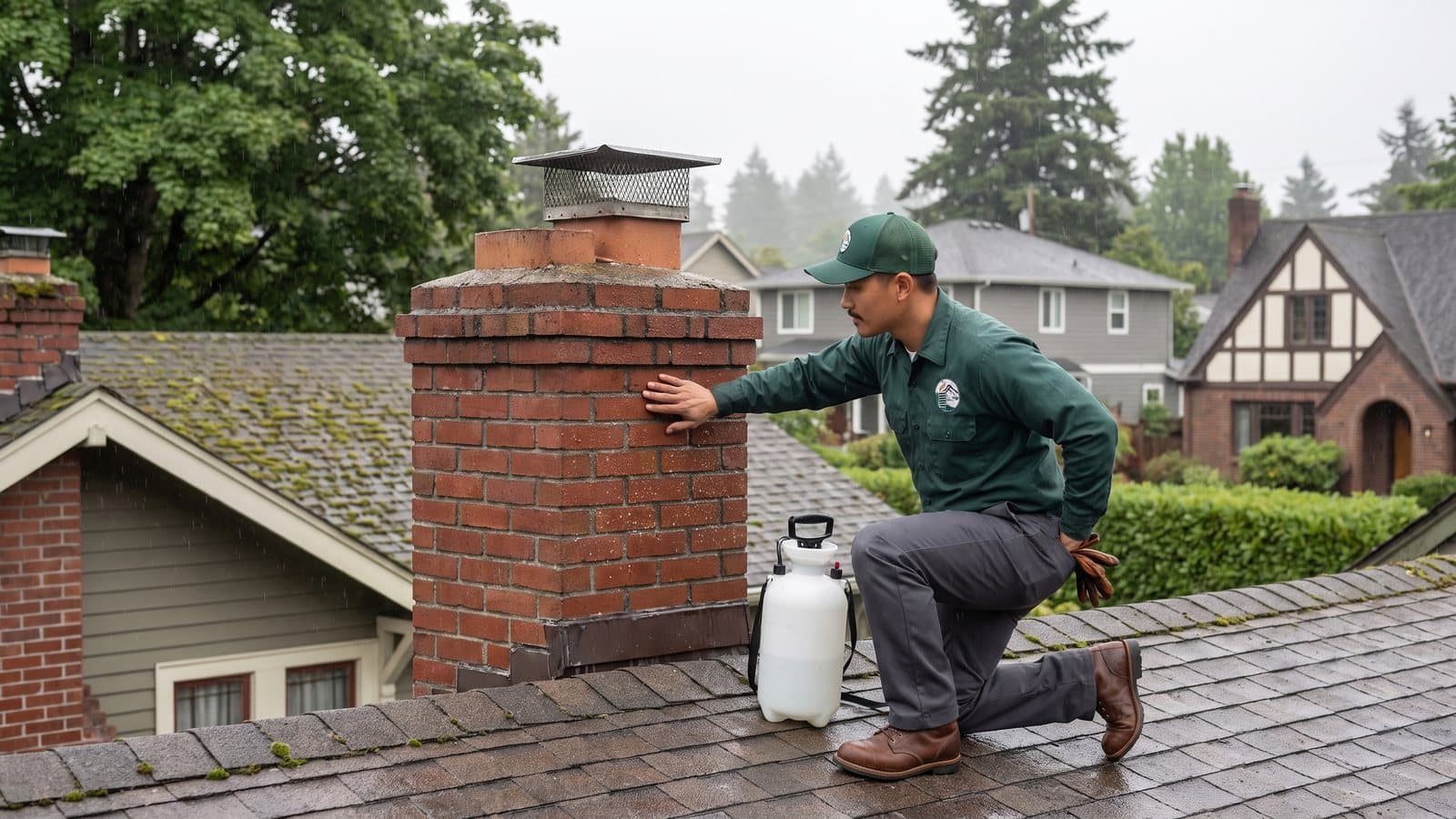
The damage starts where water collects: the crown at the top, the joints on the face that takes the rain, and the bricks right above the roofline where runoff concentrates. Wind steers it. For all but about ten weeks of summer, WeatherSpark's data has Seattle's wind arriving from the south, so the southern faces of a chimney, whether it stands on a Brighton side street or near the water in Seward Park, are where the first signs tend to show.
| Where to look | Early sign | Later sign |
|---|---|---|
| Crown (the cap slab on top) | Hairline cracks, moss along the edge | Wide cracks, chunks missing, water in the flue |
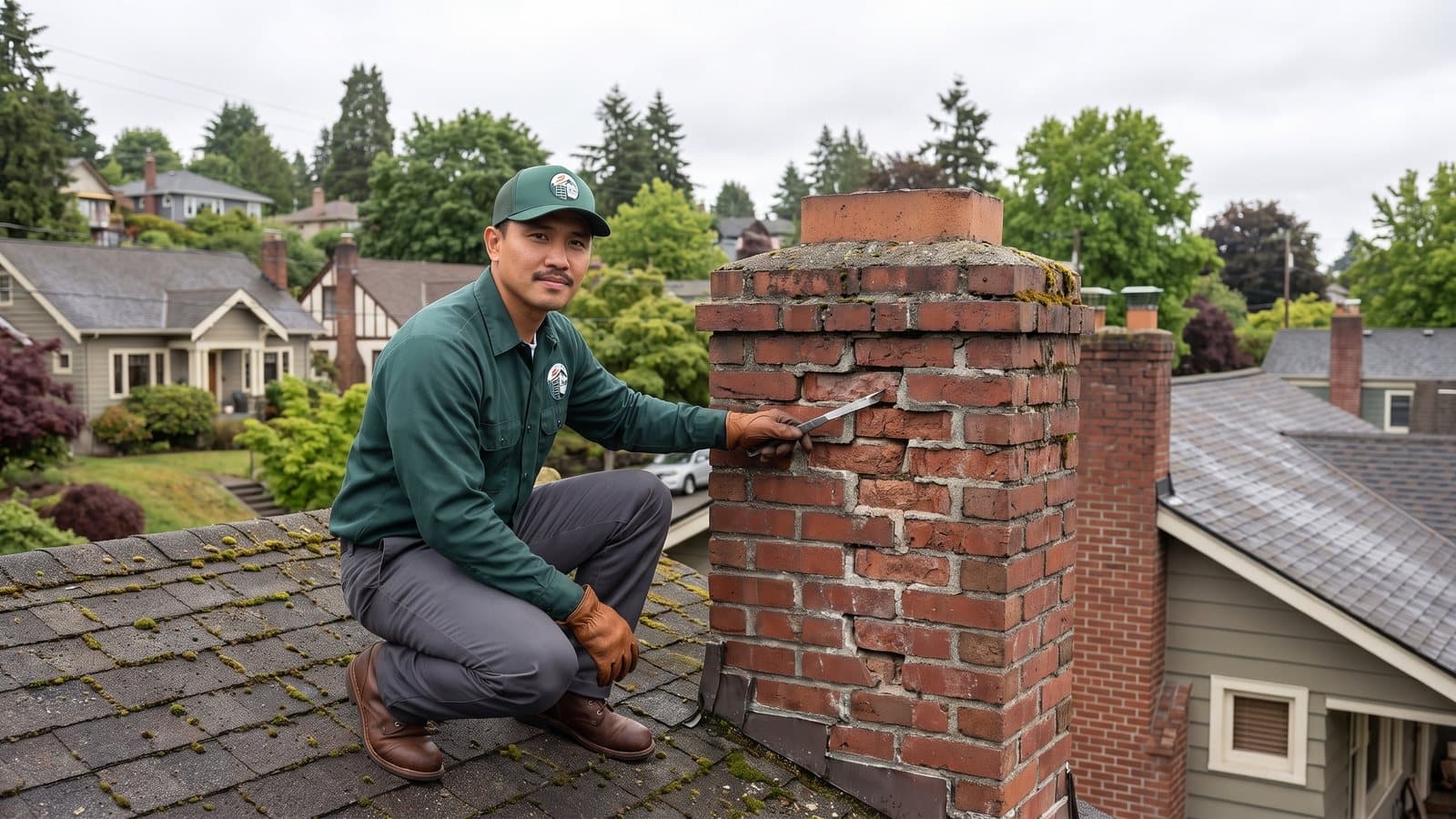
| Mortar joints | Mortar that turns to sand under a fingernail | Recessed or empty joints, loose bricks |
| Brick faces | White mineral bloom after rain | Spalled faces, chips of brick collecting below on the shingles |
| Roofline | Dark, wet bricks just above the flashing | Gaps behind the flashing, stains on the ceiling inside |
Old brick, local brick, and mismatched patches
Some of the oldest masonry in South Seattle was made close to home. According to the city's Beacon Hill context statement, Hill Brick Company dug and fired on the ridge's eastern flank, while Lohse Brick Company kept its yard where Forest Street bottoms out, and by 1905 two more brickyards operated on the west side of Rainier Avenue at the north end of the valley. Columbia City's first brick building went up in that era, built by a bricklayer named Joseph Hellenthal, and brick storefronts spread along Rainier Avenue in the 1920s.
Older brick and the soft lime-rich mortars of that period expect to move and breathe together. The trouble often comes from later repairs. A patch of hard, cement-heavy modern mortar in a soft old wall does not flex with the brick around it, so the brick gives instead: its edges crack and its face spalls while the patch stays intact. When a technician repoints an older chimney, matching the strength of the original mortar matters as much as matching its color.
Shade makes everything slower to dry. Oregon State's extension service treats moss as a given on roofs in this part of the country, fed by shade every bit as much as by rain. A chimney under tall trees, near Seward Park's old-growth forest or along one of Mount Baker's ravines, holds water longer than one in full sun, and moss on the crown or at the base keeps it there.
What Seattle's chimney rules say about repairs
Director's Rule 5-2004, the city's rule for repairing unreinforced masonry chimneys, sets the frame. Repointing on its own needs no permit, and SDCI says as much on its remodeling page. The city lets an owner relay the uppermost two feet of an unreinforced stack with matching brick; anything taller has to come back as reinforced masonry or as a factory-built metal chimney. Whatever unreinforced brick stays in place must be checked and tuckpointed where needed.
Two thresholds govern when a permit is needed for larger work, and they do not match. The 2004 rule exempts repairs costing the owner less than 4,000 dollars; the city's 2021 residential code lets minor repairs reach 6,000 dollars in a six-month period without one, provided no structural support is cut or taken out. Once a rebuild reaches into the smoke chamber, a permit follows regardless of cost, and a licensed engineer must design the rebuild of any stack standing over 12 feet above its roof. SDCI is the place to confirm which line applies to a given job.
The residential code wants the crown itself built of concrete, metal or stone, pitched to shed rain, with a drip edge along its rim and a caulked gap, the bond break, where it meets the flue tiles. Many old crowns are flat mortar washes that crack within a few winters, which is why crown work and repointing so often travel together.
Timing the work
Mortar needs dry, mild weather to cure. June 13 to October 8 is the stretch WeatherSpark identifies as Seattle's least cloudy, which makes summer and early fall the window for repointing and crown repair. An inspection in spring or early summer leaves time to plan the work before the wet season returns in October.
If a crack or loose brick shows up in midwinter, a temporary fix such as a tarp or a cap can buy time until the weather allows a proper repair.
What masonry repair runs, ours and the market's
Our masonry repair, covering crown work and repointing, starts at $475 and can reach $2,800 or more depending on how much of the stack is involved; broader chimney repair runs from $425 to $3,700. Before any of it, the inspection costs $99 plus tax per chimney, and that charge is taken off the quote you approve.
On the Seattle market, Mad Hatter Chimney Sweep's repair page prices repointing between $1,500 and $3,000, and crown repair or replacement between $800 and $1,500, while Jason L. Chimney Co.'s 2026 guide puts cracked-brick and repointing jobs at $400 to $1,200. Both pages were read on October 4, 2026. Their figures are not our quote, and neither includes a full rebuild.
Frequently asked questions
Our winters are mild. Is freeze-thaw damage really a concern here?
Less than in a cold inland climate, and we will not pretend otherwise. The Western Regional Climate Center's January figures for the lowlands around the Sound put the average overnight low somewhere from 28 to 32 degrees, so frost comes and goes on clear nights rather than locking in for months. What makes those nights count is that the brick is usually soaked when they arrive. Water does most of the work on South Seattle chimneys; frost finishes what the water started.
Does the city require a permit for repointing?
Not for repointing by itself. SDCI's remodeling page puts chimney repointing on its no-permit list, so long as nothing structural is altered. Larger repairs fall under two published thresholds, 4,000 dollars in Director's Rule 5-2004 and 6,000 dollars over six months in the 2021 residential code, and once a rebuild reaches below the top of the smoke chamber, it needs a permit at any cost. SDCI decides the close cases.
Can I just seal the brick to keep the water out?
A breathable water repellent helps sound brick shed rain, but it does not close an open joint or a cracked crown, and a film-forming sealer or paint can trap moisture inside the masonry, which makes frost damage worse. The joints and the crown come first; a repellent, if it is needed at all, goes on last.
What does spalling look like?
The face of a brick pops off in a thin layer or in chunks, leaving a rough, lighter surface behind, and the flakes tend to pile up in the valley of the roof or the nearest downspout. A few spalled bricks can be cut out and replaced; widespread spalling usually means the stack has been wet for years and needs a closer look at its crown, cap and mortar.
Sources
- WeatherSpark, Seattle year-round averages — accessed October 4, 2026
- WeatherSpark, Boeing Field averages — accessed October 4, 2026
- WRCC, climate of Washington — accessed October 4, 2026
- Beacon Hill historic context (city survey) — accessed October 4, 2026
- North Rainier Valley historic context (city survey) — accessed October 4, 2026
- Columbia City Historic District context — accessed October 4, 2026
- Oregon State Extension, roof moss — accessed October 4, 2026
- Seward Park (Wikipedia) — accessed October 4, 2026
- City of Seattle Director's Rule 5-2004 — accessed October 4, 2026
- SDCI, house additions and remodels — accessed October 4, 2026
- 2021 Seattle Residential Code, chapter 1 — accessed October 4, 2026
- 2021 Seattle Residential Code, chapter 10 — accessed October 4, 2026
- Mad Hatter Chimney Sweep, chimney repair — accessed October 4, 2026
- Jason L. Chimney Co., Seattle pricing — accessed October 4, 2026
Related services