Chimney safety
From Georgetown to Rainier Beach, a fireplace has to survive more than the fires lit in it. This page sets out what the standards, Seattle's code and the Clean Air Agency expect, and what each one means for your house.
The first is fire. In 2024, according to Washington's State Fire Marshal, 77% of the state's residential heating fires began in chimneys, flues and fuel burners, and the same office tied six deaths in the year before to home heating. The second makes no noise at all: carbon monoxide that stays indoors because a flue is blocked, cracked or sized wrong for what vents into it.
Our ten neighborhoods sit inside one city, with one building department and one clean air agency, but the houses differ. Citywide, the Census ACS 2020–2024 puts 22.8% of Seattle's housing units at 1939 or older; in the 98144 ZIP area, listed for Mount Baker and Beacon Hill, the share is 31.3%. Seattle Magazine reported in 2018 that about 85 percent of the remaining properties in the Mount Baker Park Historic District went up before 1929, while Othello's NewHolly was completed in 2005. Age tells us what to check first. It never tells us what kind of chimney a house has, so every visit starts by finding out.
Once a year
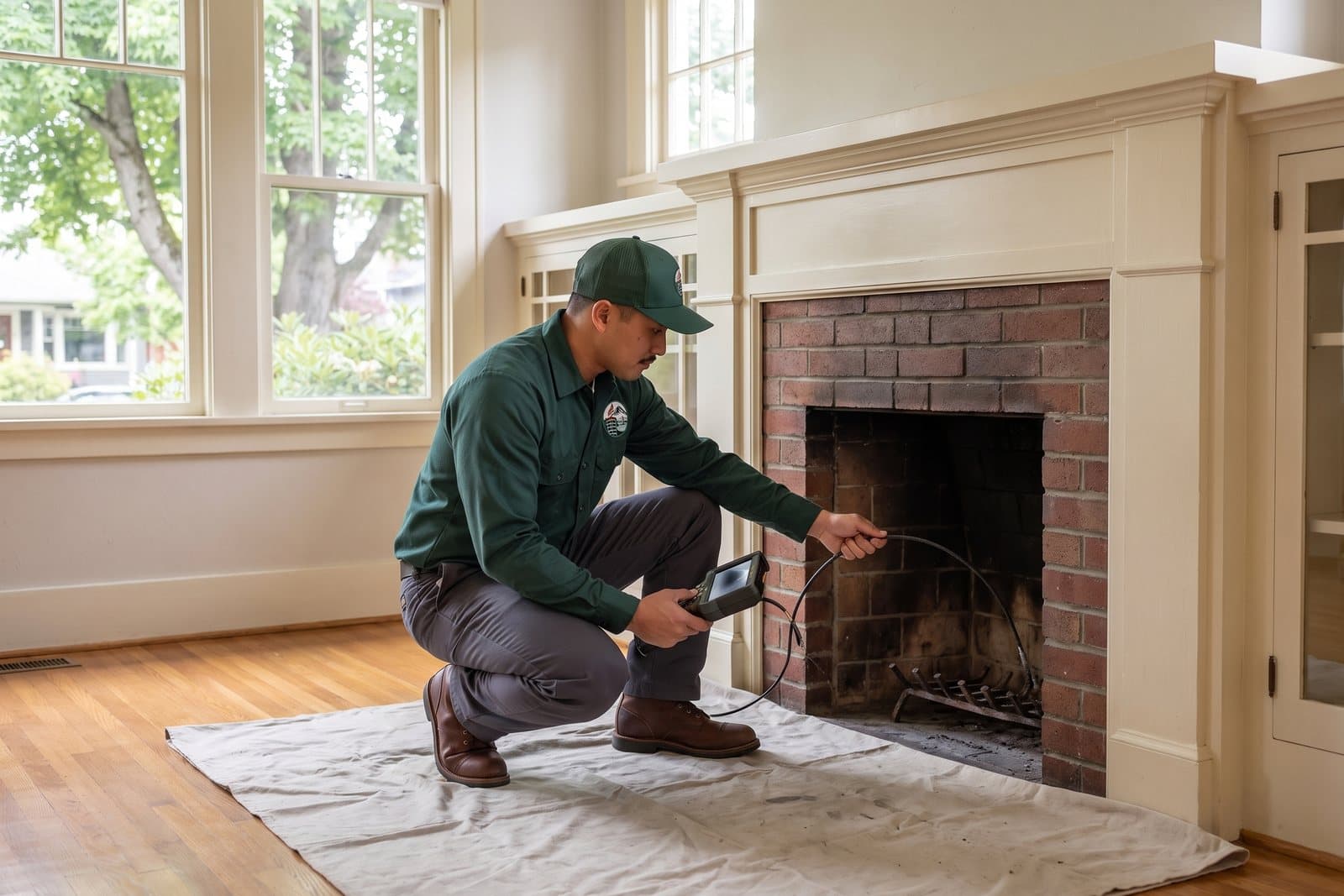
For the rule itself, CSIA sends homeowners to NFPA 211, which governs venting systems of every kind across the country. Its inspection clause wants a yearly visit, idle flues included, and boils that visit down to soundness, deposits and clearance to combustibles. You cannot settle any of those by looking at the hearth.
A chimney inspection covers all of it, from the roof and, when the two ends of the flue leave doubt, with a camera. The easiest window is Seattle's clearer season, which WeatherSpark dates from about June 13 to October 8.
Fuel in the flue
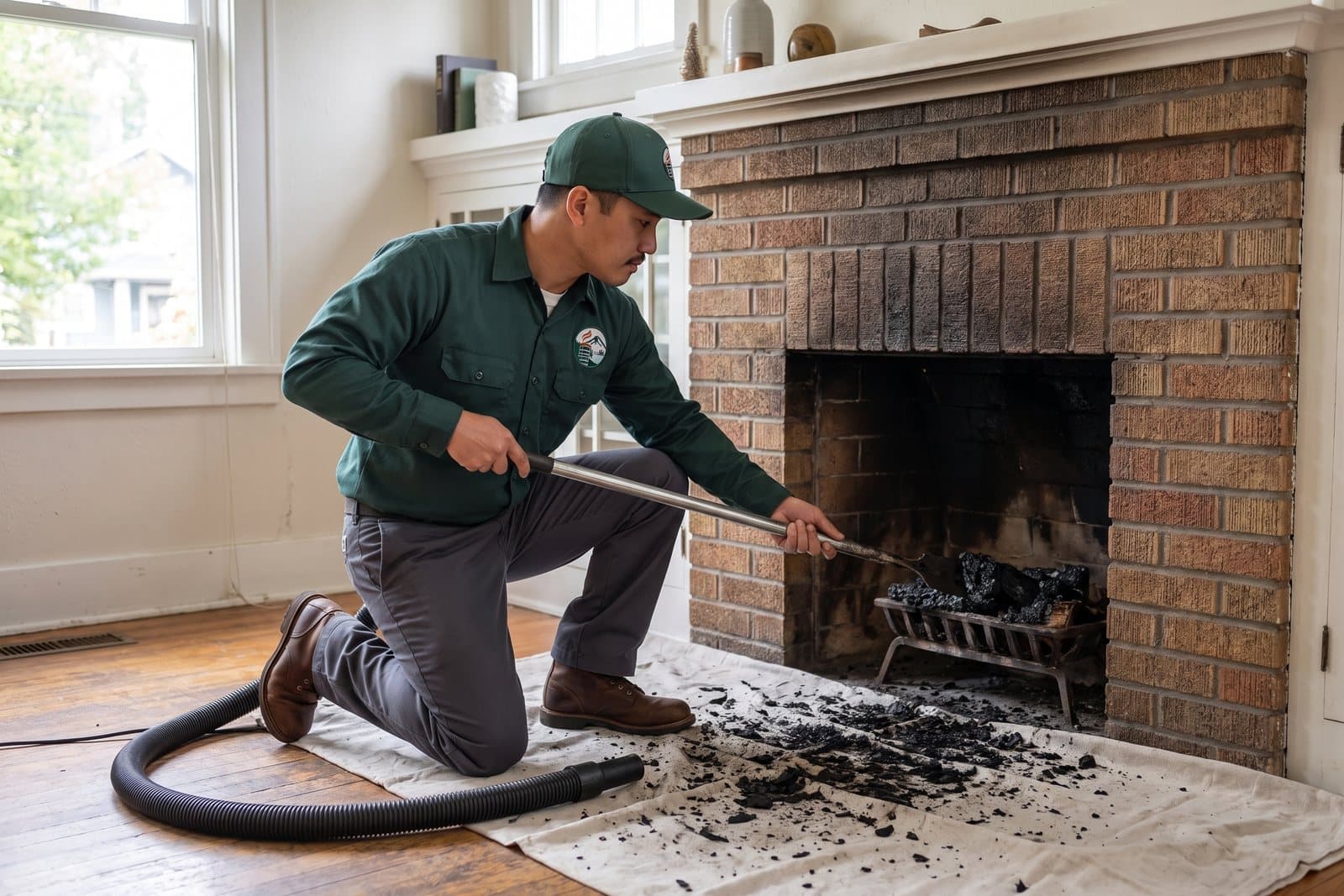
Smoke that cools on its way up drops tar on the flue wall. That residue is creosote, and it burns. CSIA's trigger for a masonry fireplace is soot 1/8 inch thick, or any glaze at all; a factory-built fireplace gets swept as soon as noticeable buildup forms. A chimney sweep handles the first two forms, and creosote removal exists for the third.
What goes in the firebox decides how fast it forms. Ecology's advice is to split wood, keep it covered and let it season a year or longer, then test it with a moisture meter. WAC 173-433-120 bars a long list from any Washington firebox, from household trash and treated lumber to plastic, rubber, paint and chemicals. Smoke density has a legal ceiling too: past 20 percent opacity for six straight minutes inside any hour, the chimney is in violation.
It has no color and no smell, and any flame in the house can make it. An open, correctly sized flue carries it out; a nest, a broken liner joint or a disconnected vent keeps it in. Put CO alarms on every floor, and if one sounds, get everyone outside before you call.
Gas in the house
Utility gas is the main heating fuel for 40.3% of occupied homes in the 98118 ZIP area, 33.8% in 98108 and 32.7% in 98144, by the Census ACS 2020–2024. Those shares describe furnaces, not fireplaces, but they explain why so many exhaust paths here carry gas combustion products. Seattle's chimney rule spells out one trap: before anyone caps or takes down a chimney, they must confirm it is not still venting another appliance, a gas water heater for instance. A liner sized to the appliance, a cap against nesting birds and an annual check of each vent connection cover most of the risk.
Clean air rules
Puget Sound Clean Air Agency is the authority behind air quality burn bans in South Seattle. Its King County trigger for Stage 1 is a forecast: fine particles expected, sometime in the coming two days, to top 35 micrograms per cubic meter averaged over a full day. Bans cluster in fall and winter, and when pollution rises quickly the agency may open with Stage 2.
Washington's curtailment rule (WAC 173-433-150) gives households three hours once a ban is announced. From then on, smoke seen leaving a chimney is prima facie evidence of illegal burning, and a fire already going must not get another log. Agency inspectors are trained to read opacity by eye, and the owner of a chimney caught breaking a ban receives a Notice of Violation.
Georgetown has a particular stake. The agency's 2016 overview of the Duwamish Valley lists home wood smoke among the sources of fine particles there, after vehicles, trucks, trains, ships and industry, and credits winter bans with keeping it in check. The Western Regional Climate Center explains the timing: lowland pollution piles up in clear, calm winter weather under temperature inversions. The agency posts current status online, with an alert sign-up. A ban day is still a fine day to have the flue swept, since sweeping burns nothing.
October 10 to April 30
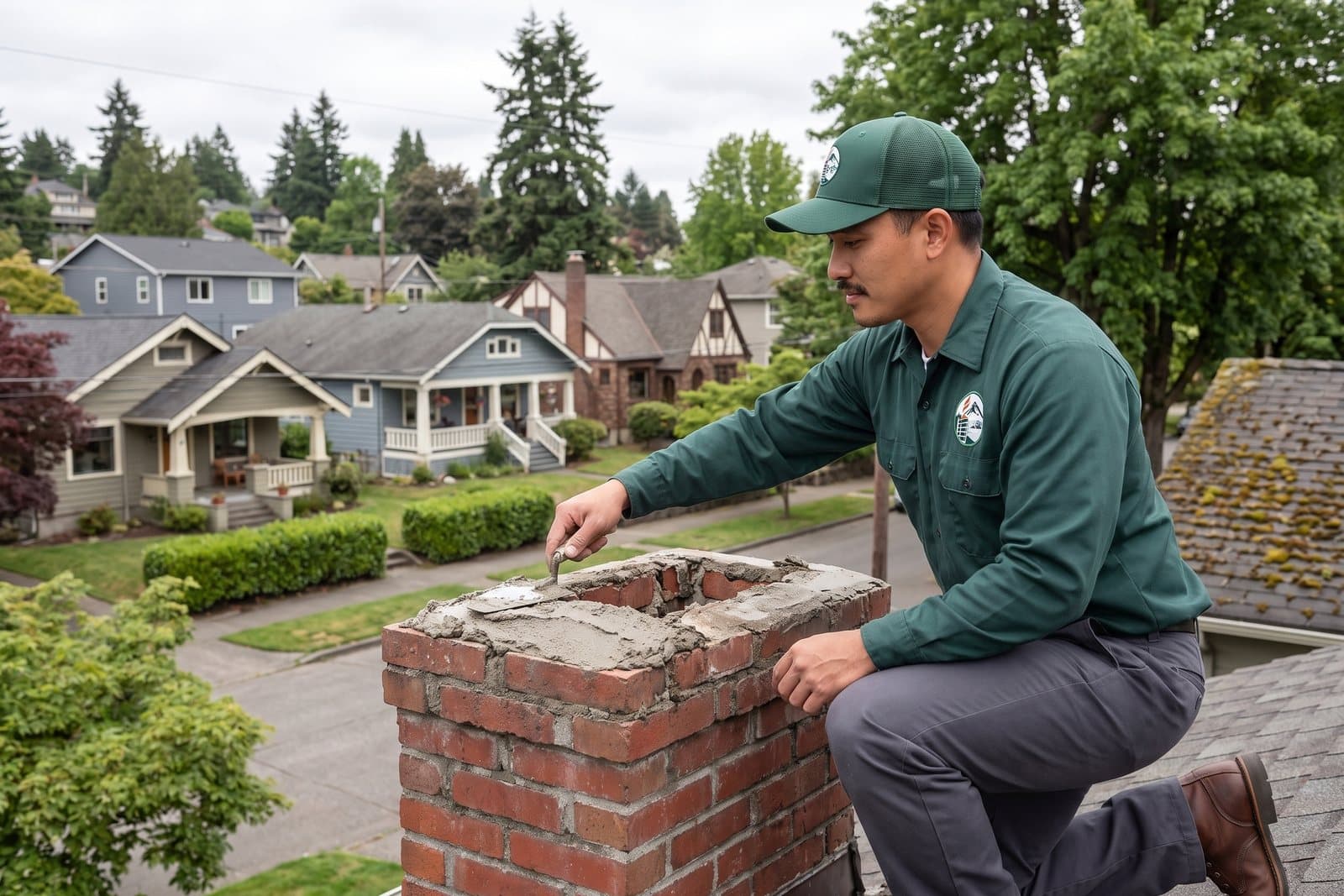
WeatherSpark marks Seattle's wetter half of the year from October 10 to April 30, and November is its peak at about 7.5 inches of rain. Drying weather is scarce in that stretch: the Western Regional Climate Center finds only 4 to 8 partly or fully clear days a month in a lowland winter. With January lows of 28 to 32°F and frost possible outside the late-April to mid-October window, water held in a crack can freeze and widen it overnight.
Seattle's code wants the top of a masonry chimney to throw water off: a sloped crown of concrete, metal or stone with a drip edge. When that has failed, masonry repair rebuilds crown and joints, and waterproofing with a vapor-permeable repellent slows the next soaking. Roof moss, which Oregon State University Extension considers unavoidable in a climate this damp, can lift the shingles around the stack too.
Seismic country
On February 28, 2001, the Nisqually quake struck at magnitude 6.8. USGS and University of Washington researchers then surveyed some 60,000 chimneys across greater Seattle and counted 1,556 damaged, and a USGS open-file report notes chimney damage at one-third of the homes FEMA inspected. EERI's reconnaissance found wood-frame houses held up well overall, with damage mostly confined to chimneys. None of these sources pins the damage on a particular South Seattle neighborhood, and neither do we. What is on record locally is the ground: Boeing Field, beside Georgetown, liquefied, and the city's emergency managers name the Duwamish Valley and the Rainier Valley among areas with liquefiable soils.
SDCI puts the odds of a damaging quake in Seattle at 86 percent over 50 years, and the Seattle Fault runs east-west through the middle of the city. After 2001, Director's Rule 5-2004 set the terms for damaged chimneys: reinforce, brace, remove or replace with a factory-built chimney. Only the top 2 feet may be rebuilt as it was; a stack more than 3 feet above the roof needs two support points, and one over 12 feet an engineer. If you felt a quake, a chimney repair assessment starts with photos of the roofline, the flue and the joint where chimney meets house.
Inside the masonry
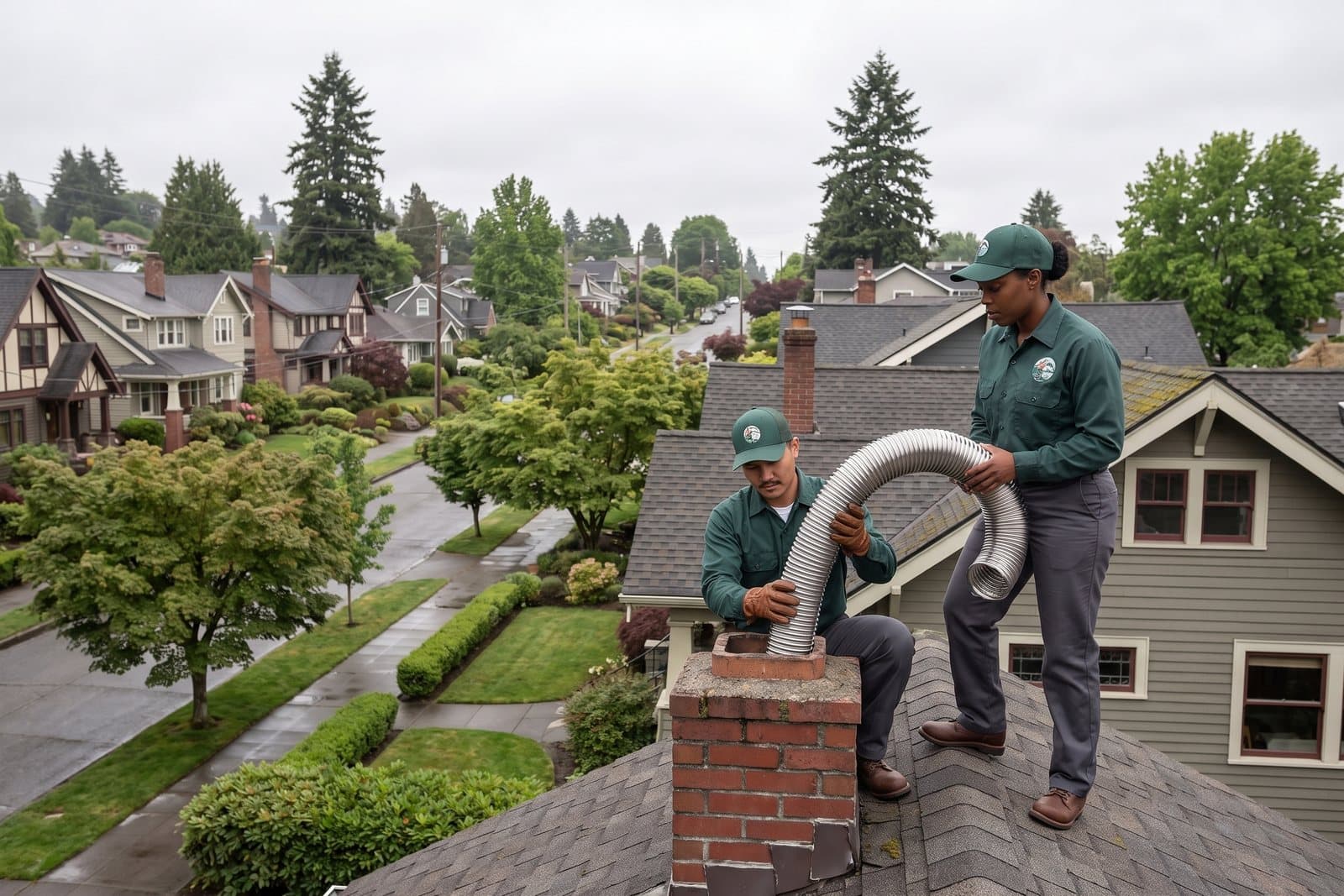
Section R1003.11 of the Seattle Residential Code forbids leaving a masonry chimney unlined, and R1003.18 sets the air spaces above. The lining keeps heat and exhaust in the flue; the gap protects the framing from whatever heat still gets through. A split tile defeats the first defense and leaves the second working alone.
Factory-built fireplaces answer to a different set of rules: listed, labeled and installed per the maker's instructions, certified to ASTM E2558 before going into any Washington home, and served by UL 103 Type HT chimneys when they burn solid fuel. When video shows a failed lining, chimney relining with one continuous stainless liner restores it.
Above the shingles
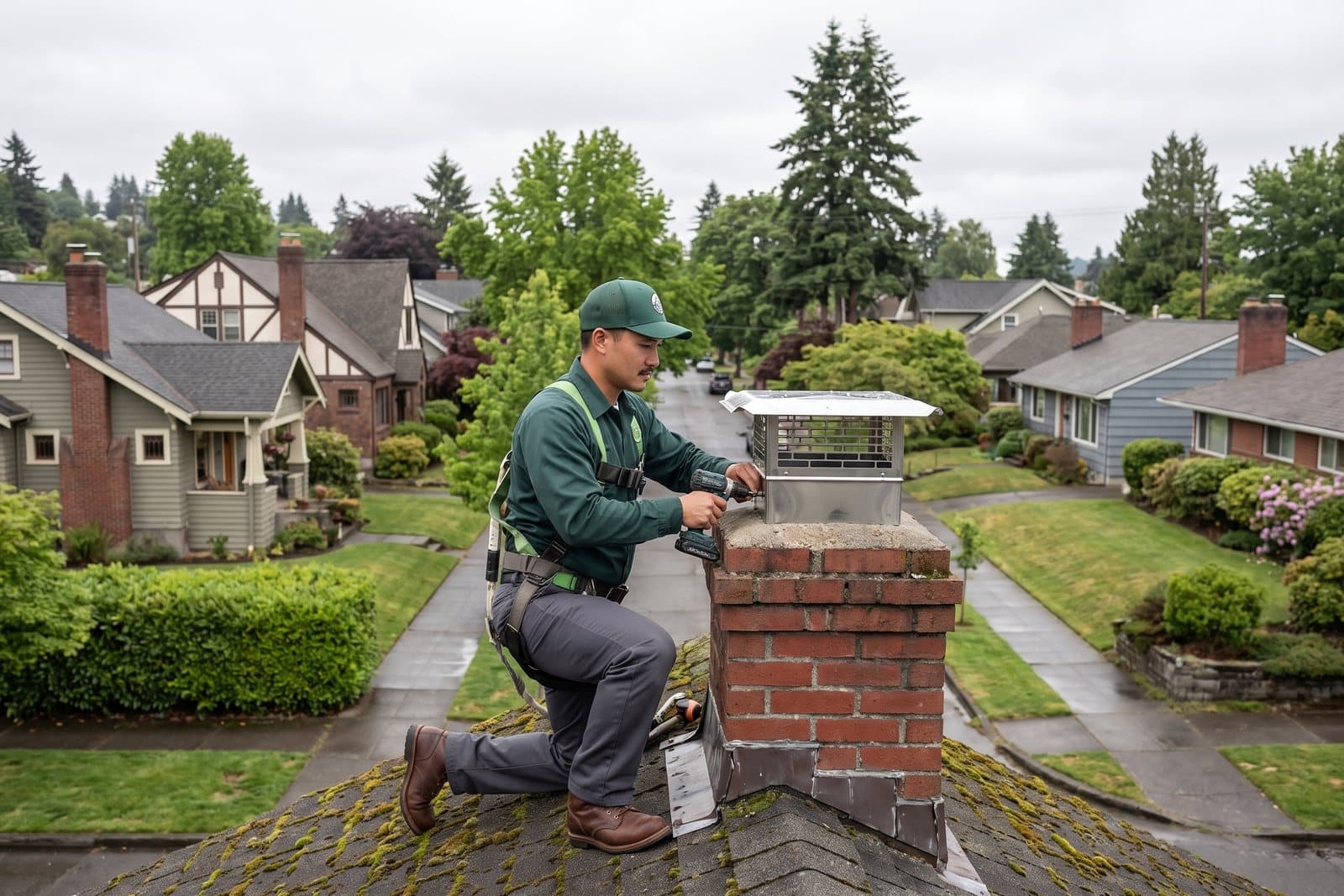
The height rule in R1003.9 serves draft and keeps sparks off the roof. A chimney cap with a spark arrestor is allowed so long as its mesh blocks a half-inch ball and leaves enough open area that the fire below still breathes. Flashing keeps the roof joint dry, and the cricket stops water pooling behind wide stacks.
Wind is the other roof hazard. The city's windstorm page describes the strongest Puget Sound storms at 60 to 70 mph sustained with gusts to 90, notes that nearly 90,000 Seattle homes predate 1939 and modern wind standards, and names falling trees as the costliest damage. Seward Park's 120 acres of old-growth forest are a reminder of how big the trees over some South Seattle roofs can be.
At floor level
Washington amends the model code on this point (WAC 51-51-1001), and the list is short. Item one: a ferrous damper, mounted no lower than 8 inches over the opening. Item two: a snug flue damper. Item three: outdoor air for the fire, ducted at 6 square inches minimum and fitted with its own working damper. Item four: doors, glass or metal, that shut tight, unless an approved draft-induction fan takes their place. SDCI's Tip 303A repeats the door and outside-air points. In front, the Seattle code's R1001.10 sizes the hearth extension: 16 inches out and 8 to each side for openings under 6 square feet, 20 and 12 for larger ones. And the State Fire Marshal's household rule still applies: children stay three feet back.
Permits
All ten neighborhoods are inside Seattle, so permits run through SDCI. Seattle applies its own 2021 Residential Code, built on the 2021 IRC with city amendments; statewide, the 2021 codes took effect March 15, 2024. Here is what the city publishes for chimney and fireplace work.
Seattle's masonry chimney rule (DR 5-2004) took effect December 1, 2004, and SDCI's Tip 303A still cites it. Under it, alterations or repairs that cost the owner less than $4,000 go without a permit, provided the work follows the rule. Minor patching is exempt outright.
Seattle's 2021 Residential Code has a broader exemption in R105.2: no building permit for minor repairs or alterations totaling up to $6,000 in any six-month span, as long as no load-bearing support is removed, cut or moved. Which threshold governs a chimney job is SDCI's call.
Once repairs reach into the smoke chamber, the rule changes: chamber and chimney are rebuilt entirely to current code, under a building permit, regardless of cost.
SDCI's remodel page lists repointing a chimney, along with replacing roofing or siding, as work that needs no permit when nothing structural changes. The 2021 code puts chimney repointing on its exempt list as well.
Tip 303A calls for a separate furnace permit for a wood stove and expects fireplaces and stoves to meet emission certification. Gas piping is the exception to the mechanical permit, which otherwise takes in new heating and venting equipment; piping is permitted separately.
Inside the district, designated in 1978, no permit is issued for exterior work until a Certificate of Approval is in hand. The city page does not name chimneys, so ask about visible masonry work before it is booked.
With a permit, the chimney rule calls for three inspections: after demolition, before the bond beam concrete is placed, and at completion. When the two cost thresholds above point different ways for your job, SDCI decides, and we check with them first.
Who does what
Most fire prevention happens in the household, day to day. Work inside the flue, on the roof or on a gas connection needs tools, training and fall protection.
Before October 10
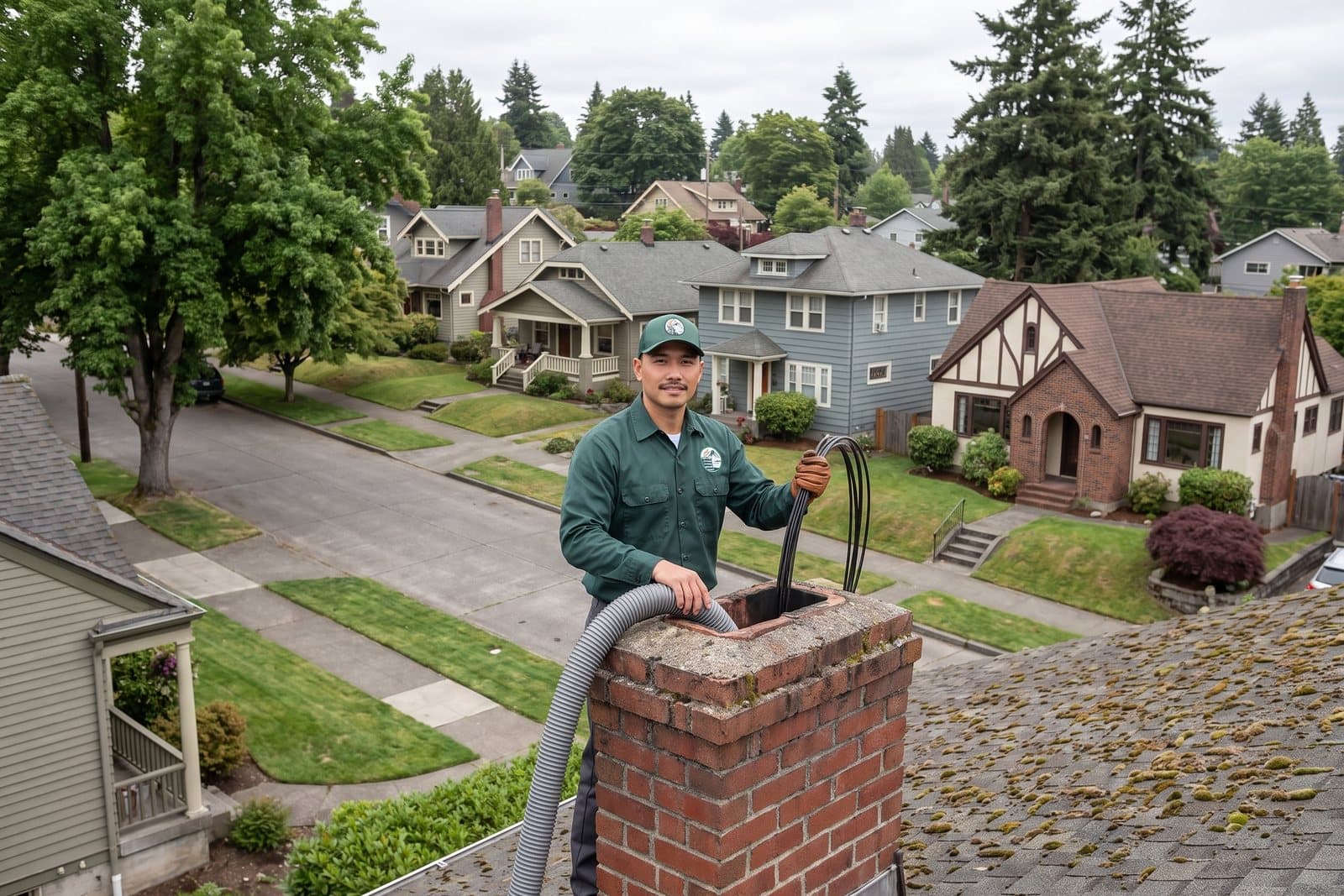
Summer leaves room to finish any repair it finds before the wet half of the year begins.
1/8 inch of soot or any glaze means yes. The inspection measures it for you.
A missing or tilted cap, plants in the crown, lifted flashing: binoculars from the yard show a lot.
Split, raised off the ground, covered on top, and at least a year old. Spring-cut logs belong to next winter.
The Clean Air Agency sends them. A minute of setup now avoids a Notice of Violation later.
Keep reading
The blog takes one question at a time and names the source behind each fact it uses.
Questions
Sources
Each figure and rule above was checked against the original document on October 4, 2026. NFPA 211 is behind a paywall, so its inspection requirement is cited through CSIA's summary.
South Seattle Chimney Pros checks it top to bottom, photographs each part and writes up what we find. The visit is $99 plus tax, and that amount comes off the repair if you approve the quote.