Every wood fire sends tar, unburned gases and fine particles up the flue. Where the flue wall is cool enough, some of that condenses and sticks, and the layer it forms is creosote. It burns readily, which is why a thick coat turns a chimney into a fuel line. In South Seattle the biggest supplier of creosote is not the fireplace but the woodpile: firewood that never got dry. This guide covers how the deposit forms, how to tell its stages apart, what keeps it thin, and what to do if it ever catches.
Why some flues coat faster than others
Creosote is a condensation problem. Smoke leaves the firebox hot and full of vapors; as it climbs, it cools, and whatever it is carrying settles on any surface below roughly the point where those vapors turn back to liquid. A hot, lively fire pushes most of that load out the top. A slow, smoky one lets it cling a few feet above the damper.
Four habits make it cling sooner. Wet wood spends its energy boiling off water and never gets hot. A fire choked down to last all night smolders. An exterior chimney on a north wall stays cold for the first half hour of every fire. And a flue far wider than the appliance it serves, common when a modern insert is dropped into an old masonry opening without a properly sized liner, lets the smoke slow down and cool. Seattle's residential code rules out the bare-brick flue anyway; it accepts clay tile or a listed lining system, among other options.
Reading the deposit
Sweeps describe creosote in three rough stages, and the stage decides the tool. CSIA puts the cleaning line for a masonry fireplace once soot on the flue wall builds to about an eighth of an inch, or sooner if any of it has glazed. On a factory-built fireplace, its advice is to clean as soon as a buildup can be seen at all.
The table below is a field guide, not a diagnosis. A camera run up the flue shows what a flashlight from the firebox cannot.
| Stage | What it looks like | What usually removes it |
|---|---|---|
| First stage | Dry, dark, powdery soot that smears on a fingertip | A standard sweep with brushes and a vacuum |
| Second stage | Crunchy, porous flakes, a bit like burnt cereal | Stiffer rotary tools, sometimes a second pass |
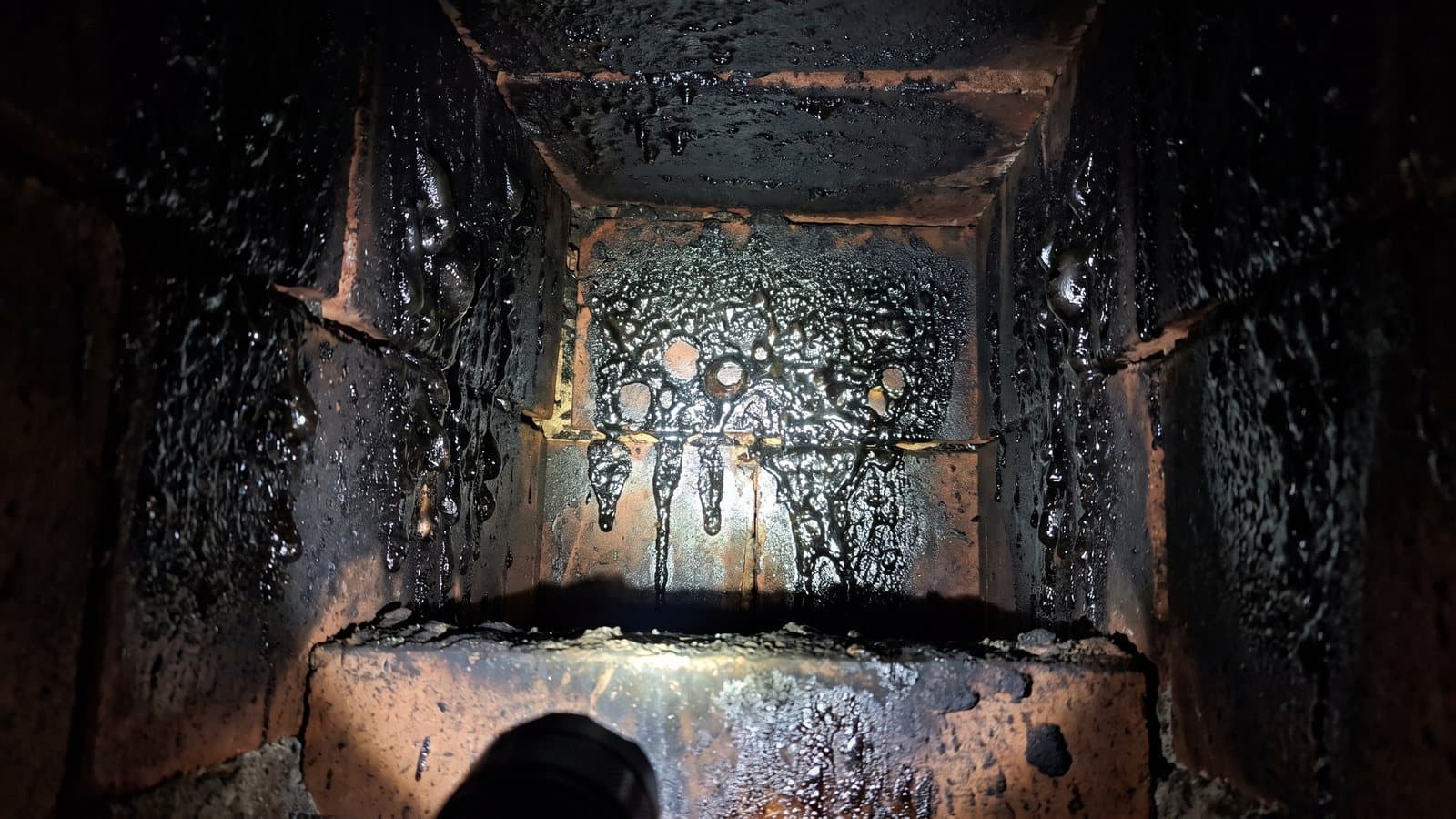
| Third stage | Shiny, tar-like glaze, sometimes dripping or bubbled | Chemical treatment and rotary removal over one or more visits, or relining if the tiles are damaged |
Wet wood in a wet city
A log cut last spring and left in an open pile beside a Hillman City garage has had a rough year. WeatherSpark counts close to seventeen wet days in an average Seattle November, with about seven and a half inches of rain, and WeatherSpark's wet season stretches from about October 10 until April closes out. Wood stacked in the open through that stretch can soak up much of what it lost in the summer.
The Washington Department of Ecology's firewood advice fits this climate well: split the wood, stack it under a cover, give it a year or longer, and check it with an inexpensive moisture meter before burning. Ecology also warns against loading damp pieces or cramming the firebox full, both of which waste fuel and smoke heavily. Cords sold as seasoned in October deserve a meter test too; a cut end that hisses or bubbles in the fire is the giveaway that the label was optimistic.
Smoke you can see is a warning on two fronts
A fire that coats the flue also shows up at the top of the chimney. State rules cap how opaque chimney smoke may be at 20 percent, and Puget Sound Clean Air Agency counts more than six minutes in a row over that limit within any hour as a violation; its field staff learn to read smoke density by sight. Thick gray or yellow smoke after the first few minutes of a fire means the same thing to them as it does to a sweep: incomplete burning.
The agency's burn bans come on calm, cold days when inversions hold smoke near the ground, which the Western Regional Climate Center describes as the typical late-fall and winter pattern in the Puget Sound lowlands. Its 2016 overview of the Duwamish Valley, home to Georgetown, lists home wood smoke among the sources of fine particles there, alongside trucks, trains, ships and industry. Most homes cannot claim an exemption from a ban: the agency calls heat adequate when the house can keep every occupied room at 70 degrees Fahrenheit at a height of three feet, which is what building codes already demand.
After a long outage, plan a look
Chimneys that see a few fires a year sometimes get a month's worth in a week. The city's windstorm page recalls the December 2006 storm, when Seattle City Light counted 49 percent of its customers cut off; most had it back within two days, but the last homes waited a week. A fireplace pressed into round-the-clock duty, often with whatever wood was on hand, can build more creosote in those days than in several normal winters.
If your household rode out an outage on the fireplace or stove, schedule an inspection before the next season rather than waiting for the usual date. The same goes for a cold snap that kept a stove going for days on end.
If the chimney catches
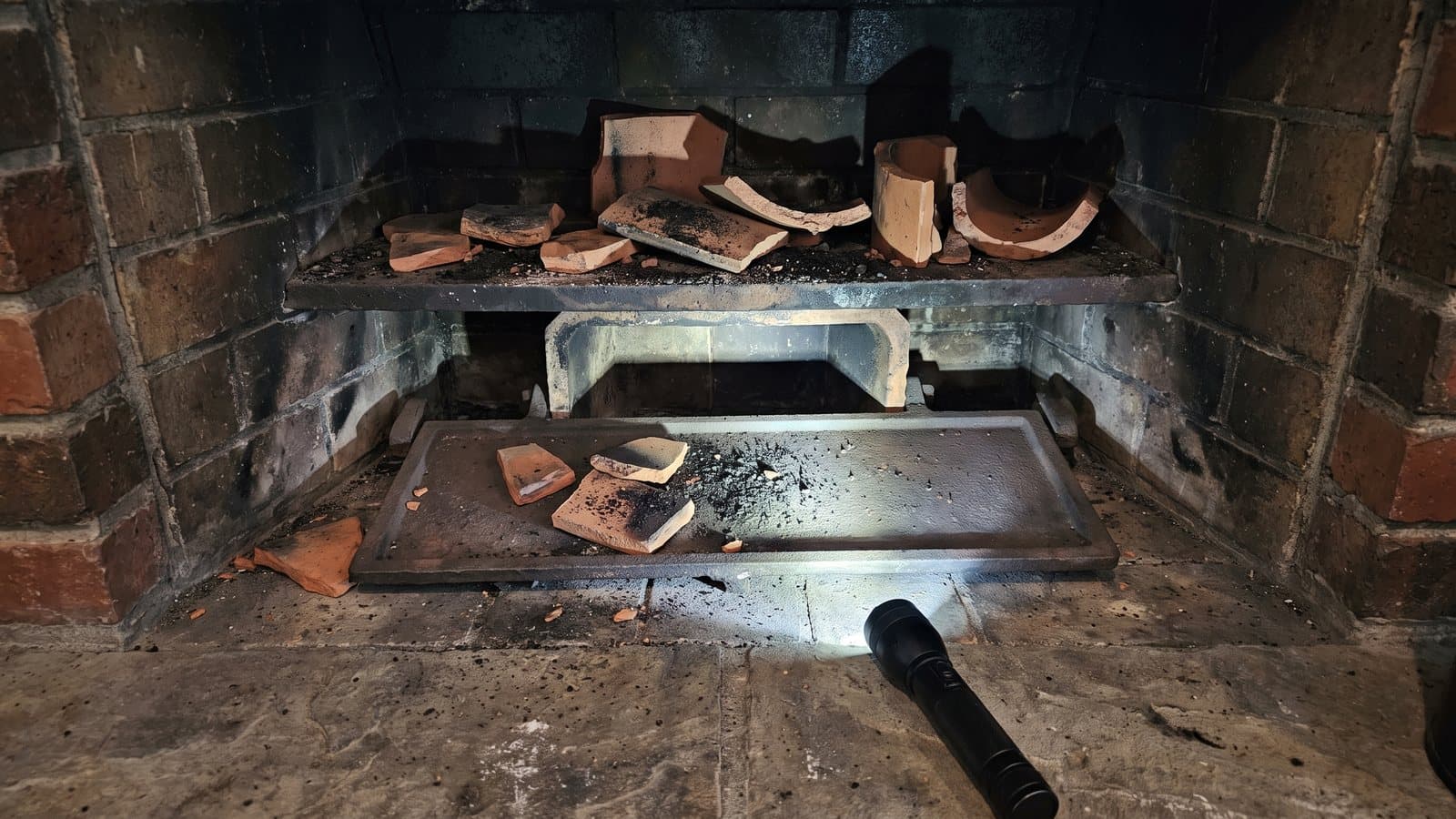
A fast chimney fire is loud: a roar like a passing train, popping, a hard draft pulling at the room, sometimes flames or sparks shooting from the top. Leave the house with everyone in it, then dial 911 from outside; hoping it dies down on its own is not a plan. Slow-burning chimney fires make less noise and are often found only later, when a technician sees puffy, honeycombed creosote, cracked flue tiles or a warped cap.
Whichever kind it was, nobody should light that fireplace again before a technician has looked up the flue. Ashes from any fire belong outside once they are completely cold, in a metal can with a tight lid set well away from the house, per the State Fire Marshal, who also asks that children stay three feet back from a burning fireplace.
What removal runs, ours and the market's
A routine sweep with us runs $189 to $449. Heavier creosote removal starts at $245 and can reach $585 or more when the deposit is glazed and needs several passes. Before any of that comes the inspection, $99 plus tax, an amount we deduct from whatever quote you approve.
For context, Mad Hatter Chimney Sweep, one Seattle company that publishes its rates, puts heavy second- and third-stage creosote removal at $300 to $600 and up, according to its Seattle pricing article read on October 4, 2026. That figure is theirs, not our quote, and the market rate for glazed deposits moves with how many visits the job takes.
Frequently asked questions
Do creosote-removing logs work?
They can dry out and loosen some soft deposits so they flake off, which is better than nothing between visits. They do not scrape a flue, they cannot reach a smoke shelf, and they do nothing for glazed creosote. Treat them as a supplement, never as the cleaning, and never as the reason to skip the yearly look.
Does a gas fireplace build up creosote?
Natural gas does not leave creosote the way wood does. A gas unit still needs its own yearly service, because a burner that runs out of adjustment can produce soot, and the vent can be blocked by debris or a nest. If your fireplace was converted from wood to gas, the old flue may still hold creosote from the wood years, and that is worth checking once.
Is it true that burning pine causes creosote?
Moisture matters far more than species. Well-dried softwood burns hot and quick and leaves little behind; any wood, oak included, that goes into the firebox wet will smolder and coat the flue. In this climate the real question is not which tree the log came from but whether it spent a full year drying under a roof.
How often does a wood stove or insert need sweeping?
It depends on how much you burn and how dry the wood is, not on the calendar. A household that heats with an insert most winter evenings can reach CSIA's one-eighth-inch threshold well before spring, while a stove lit on a few weekends may go a year or more. The yearly inspection tells you which case you are in; a mid-season check makes sense in a heavy-use winter.
Sources
- CSIA, resources for homeowners — accessed October 4, 2026
- Seattle Residential Code 2021, chapter 10 — accessed October 4, 2026
- WeatherSpark, Seattle climate by month — accessed October 4, 2026
- Department of Ecology, wood stove information — accessed October 4, 2026
- PSCAA, legal overview of wood burning — accessed October 4, 2026
- PSCAA FAQ on burn ban exemptions — accessed October 4, 2026
- Western Regional Climate Center, Washington narrative — accessed October 4, 2026
- PSCAA, Duwamish Valley air quality (2016) — accessed October 4, 2026
- Seattle emergency management, windstorms — accessed October 4, 2026
- State Fire Marshal (WSP), heating safety — accessed October 4, 2026
- Mad Hatter Chimney Sweep, Seattle cost article — accessed October 4, 2026
Related services