The liner is the part of a chimney you never see: the tube, usually clay tile in an older house, that carries smoke and heat up through the brick and keeps both away from the wood framing around it. When it cracks, shifts or no longer matches the appliance below, the chimney keeps working, more or less, which is exactly why a failing liner gets missed. These are the signs that point to it, in the order homeowners usually notice them, and what it takes to confirm them.
What the liner does, in one paragraph
A liner does three jobs. It contains heat, so the brick and the framing beside the chimney never get hot enough to char. It contains combustion gases, so they cannot seep through mortar joints into an attic or a bedroom wall. And it gives the smoke a smooth, correctly sized path, which is what makes a chimney draw. Seattle's residential code does not let a masonry chimney go without one: section R1003.11 names clay flue tile meeting ASTM C315 and listed systems tested to UL 1777 among the accepted linings.
The clues, from the firebox up
Most of these clues have more than one possible cause, which is why none of them is a verdict on its own. Two or three together, or any one of them after a chimney fire or an earthquake, are reason enough for a camera inspection.
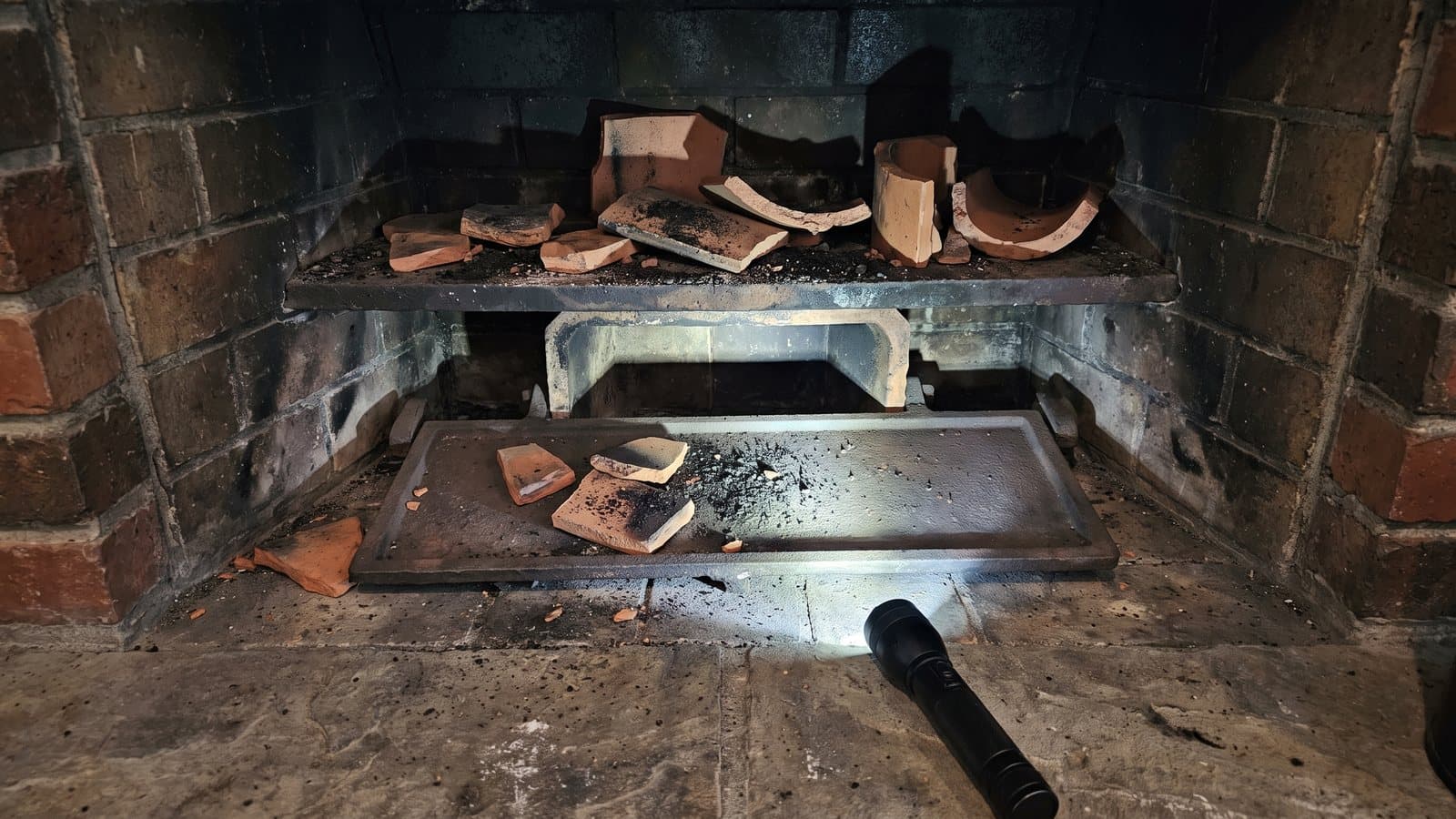
Pieces of tile are the clearest sign. Thin, curved, terra-cotta colored shards on the smoke shelf or in the ash are fragments of the liner itself, and they mean a section has spalled or broken.
| What you notice | What it can point to | How it is confirmed |
|---|---|---|
| Curved terra-cotta shards lying in the ash or on the shelf above the damper | Cracked or spalling clay tiles | Camera run up the full flue |
| Smoke or a sharp smell in an upstairs room or the attic when a fire is lit | Gaps in the liner or its joints letting gases through the masonry | Camera, sometimes a smoke test |
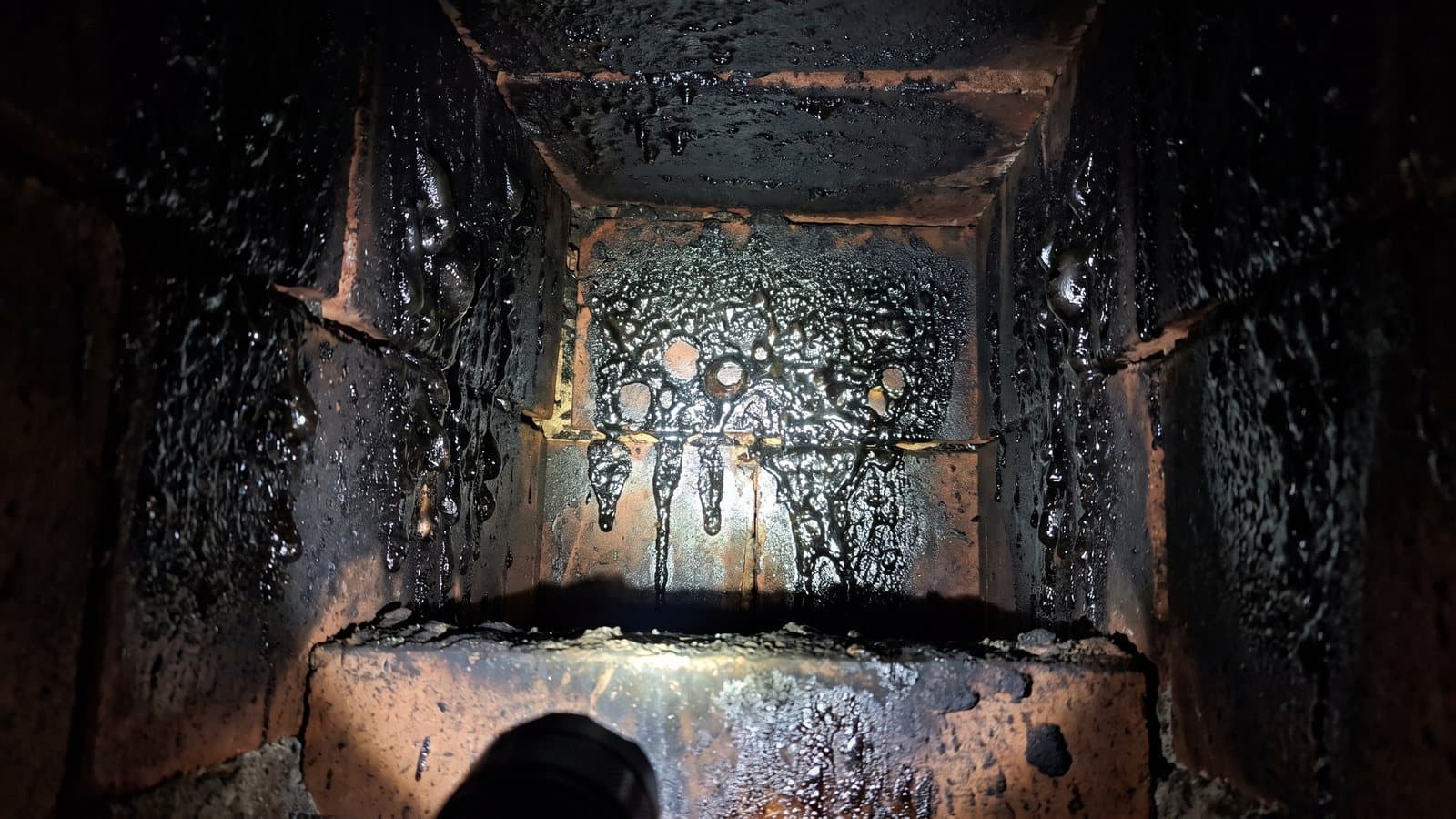
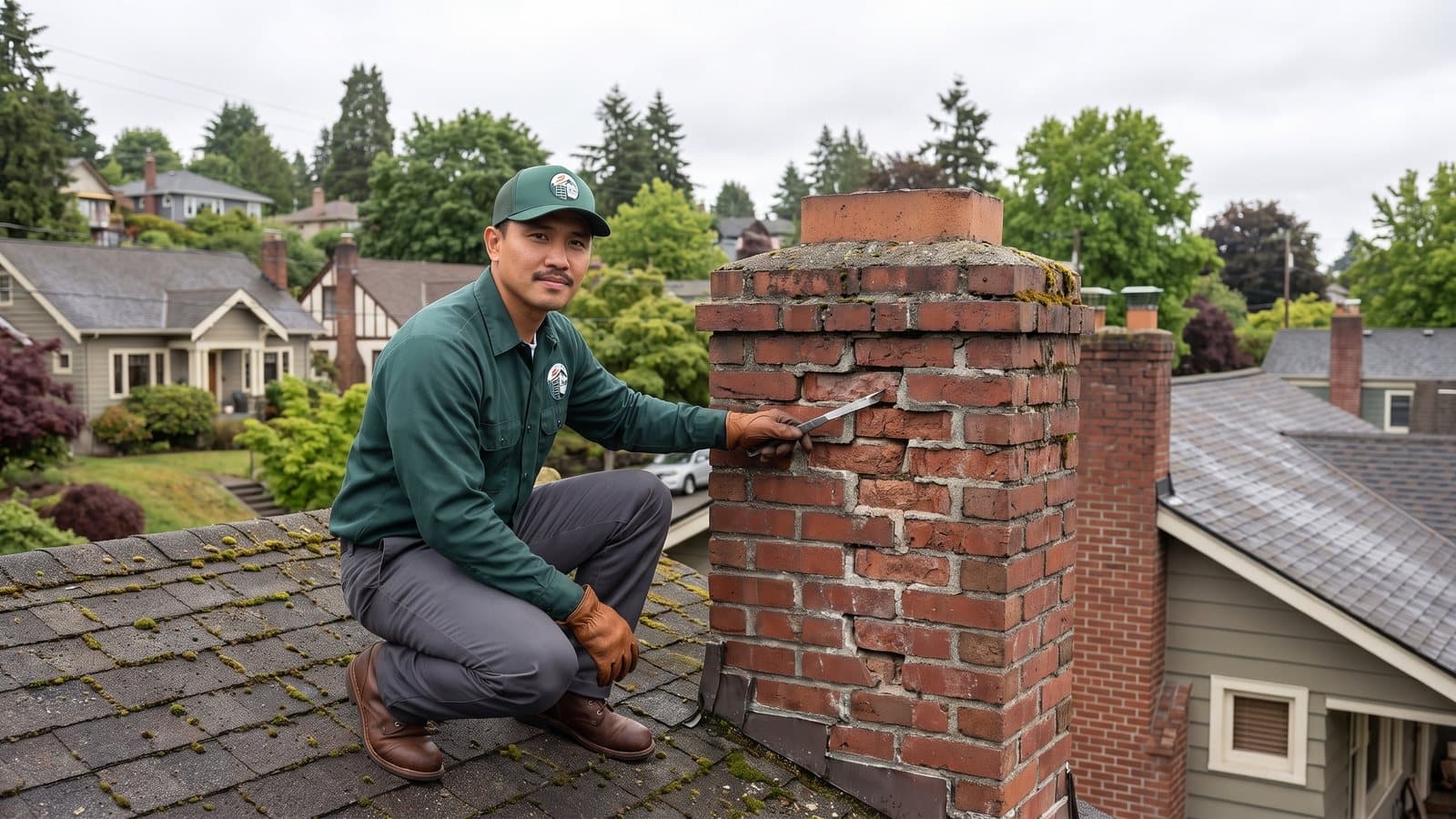
| A campfire odor indoors on rainy days with no fire burning | Creosote and moisture working through damaged tile or mortar | Camera plus a look at the crown and cap |
| Brick flaking or white staining on an inside wall near the chimney | Moisture condensing inside the flue and wicking outward | Camera, moisture check, appliance venting review |
| A fire that smokes into the room or is hard to start | A flue too large or too small for the fireplace, or partly blocked | Flue measurement against the opening or appliance |
| Loud roaring during a past fire | A chimney fire that may have cracked the tiles | Camera inspection before the next use |
When nothing looks wrong but the liner still has to change
A liner can be in perfect shape and still be the wrong one. The common case is a new appliance. A wood insert set into an old masonry fireplace needs a liner sized to its outlet, run from the insert to the top of the chimney; venting it straight into a tile flue several times larger lets smoke slow, cool and coat the walls. SDCI's Tip 303A adds a paperwork point, since the city permits a wood stove as a furnace, separately from the building.
The other common case runs the opposite way. Census tables still show fuel oil as the main heat in 4.8 percent of homes in the 98108 ZIP area and 2.7 percent in 98118, and when one of those oil furnaces is pulled out, its replacement often vents through a wall instead. A water heater left alone in the old flue may then not produce enough warm exhaust to keep it dry and drawing. The fix is usually a smaller liner for the remaining appliance.
Older houses, more years of heat and shaking
Many South Seattle neighborhoods filled in early. The city's North Rainier Valley context statement describes Columbia City as largely built out with single-family houses by 1920, and Mount Baker's survey places most of its older homes in two bursts, from about 1905 to 1920 and through the 1920s. Beacon Hill's east slope added a later layer, mostly ranch houses, between 1950 and 1962. Those are house ages, not chimney types: a 1915 house may have a tile-lined brick chimney, an unlined one or a later metal flue, and only an inspection says which.
What age changes is the list of things a liner has been through. After the 2001 Nisqually earthquake, FEMA's teams visited roughly 30,000 houses and one-third had chimney damage, a USGS open-file report notes, and a crack inside a flue does not show from the yard. EERI's reconnaissance team found that wood-frame houses came through that quake well overall, with damage mostly confined to the chimneys. Any flue that has not had a camera inspection since then has a gap in its history.
How the inspection settles it
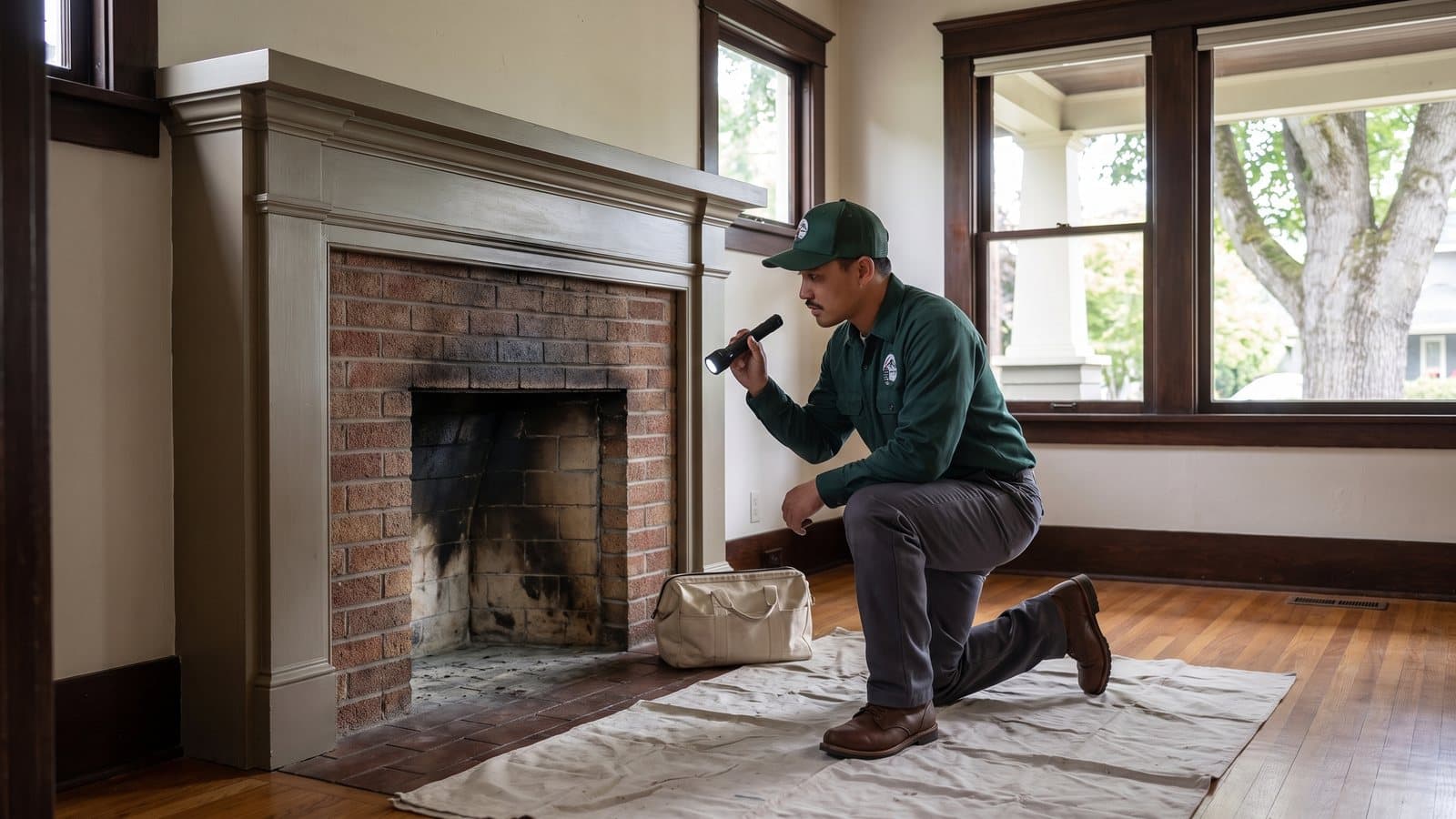
A flashlight from the firebox shows a few feet of flue. A liner verdict needs the rest, so the technician runs a camera from the damper to the top, or from the top down, and records the joints, cracks, gaps and deposits along the way. You get the pictures. If the tile is sound but dirty, a sweep may be all it needs; if a few joints are open near the top, a repair may do; if cracks run the length of the flue, or the size is wrong for the appliance, relining is the answer.
One rule shapes larger jobs in this city. Director's Rule 5-2004, which governs repairs to unreinforced masonry chimneys, sets a hard line at the smoke chamber: if the work reaches deeper than its upper edge, both that chamber and the chimney must be brought fully up to today's code, with a permit, regardless of price. A liner dropped into a sound chimney rarely goes that far, but the inspection report should say so plainly.
What relining runs, ours and the market's
Relining with us begins at $1,900, the price of stainless pipe dropped through the full flue height; a tall chimney, a wide flue or a poured lining can take it to $5,900 and beyond. First comes the inspection that settles whether you need one: $99 plus tax a chimney, subtracted from the relining quote once you approve it.
Two other Seattle companies put installed figures online. Mad Hatter Chimney Sweep's liner page runs from $1,200 up to $2,500 for stainless and from $2,000 up to $4,000 for a cast-in-place cement lining; Jason L. Chimney Co.'s 2026 guide shows the same $1,200 floor and $2,500 ceiling for stainless work. We read both on October 4, 2026. Their market price is not our quote, and neither range includes repairs to the masonry around the flue.
Frequently asked questions
Can a cracked clay flue tile be patched instead of relining the whole chimney?
Sometimes, when the damage is limited to one or two tiles near the top that can be reached and replaced. Cracks deeper down cannot be reached without opening the chimney, and a single crack is often a sign that the whole run went through the same heat or the same shaking. A camera inspection shows how far the damage goes before anyone recommends one path or the other.
Our old oil furnace was replaced by a high-efficiency one. Why is the chimney suddenly a concern?
A high-efficiency furnace usually vents through its own plastic pipe, which can leave a gas water heater alone in a flue sized for two appliances. The smaller flow of exhaust cools on the way up, its moisture condenses on the masonry, and the draft can weaken. In South Seattle, where Census figures show a few percent of homes still heat mainly with fuel oil, those switches still happen every year. A technician checks whether the remaining appliance needs a smaller liner.
Which liner is right for my chimney?
Three things decide it: what you burn, what you burn it in, and how the flue is built. Stainless steel is the usual choice for wood inserts, stoves and most gas appliances, and it can be sized to the appliance outlet. A poured cement lining suits a damaged masonry flue that also needs its walls strengthened. Clay tile is mostly a new-construction material. Seattle's code accepts clay tile meeting ASTM C315 or a lining system listed to UL 1777, among other options, so whatever goes in has to carry the right listing.
Does relining need a permit in Seattle?
Per SDCI's Tip 303A, putting in a wood stove calls for a furnace permit of its own, and the 2021 Seattle Residential Code and Director's Rule 5-2004 set two different dollar lines, 6,000 and 4,000, below which minor chimney repairs need no building permit. A relining job can fall on either side of those lines, and its permit can depend on the appliance it serves. We tell you before work starts which permit, if any, the job needs, and SDCI has the final word.
Sources
- Seattle Residential Code 2021, chimneys chapter — accessed October 4, 2026
- SDCI Tip 303A, residential code requirements — accessed October 4, 2026
- Director's Rule 5-2004 on masonry chimney repair — accessed October 4, 2026
- Seattle Residential Code 2021, chapter 1 exemptions — accessed October 4, 2026
- Census ACS heating fuel, table B25040 — accessed October 4, 2026
- North Rainier Valley context statement, 2004 — accessed October 4, 2026
- Mount Baker context statement (Tobin) — accessed October 4, 2026
- Beacon Hill context statement (Tobin) — accessed October 4, 2026
- USGS report 03-211, Nisqually earthquake — accessed October 4, 2026
- EERI and UW, Nisqually reconnaissance report — accessed October 4, 2026
- Mad Hatter Chimney Sweep, liner installation — accessed October 4, 2026
- Jason L. Chimney Co., pricing guide 2026 — accessed October 4, 2026
Related services